Many Ways; Many Gifts
07 Jan 2026 Posted in:digital humanities writing I was asked by Katina Rogers to be a part of an MLA 2026 roundtable titled “Writing in the Margins: The Freedom of Scholarly Work in Non-Disciplinary Spaces.” Given the format, I don’t have fully written remarks for what we’ll be discussing. But, in the spirit of the conversation, I thought it could be worth sharing a sketch of what I will offer. What follows are my slides and a few thoughts.
Writing has always been a part of my life, but the last two years have made me rethink what that means in several key ways. These years brought the birth of our first child and preparations for our second. I have far less time or energy to give to writing. All the same, writing continues to offer me the best way to work through my own anxieties about the world as it is, the job that I have, and the ways that I would rather both of them be. This tension—the urgency of writing against the pressures put on it by things that, frankly, are often more important—has resulted in some real creative gymnastics that I will share with you today. I have had to re-evaluate how I write, what I write, and why I do so. Central to my practice has always been the idea that all writing is useful, and this belief has proven more important than ever as we chase a toddler around the house. The care that needs to be given comes first, so writing has changed in important and useful ways as it fits into the cracks of the day.
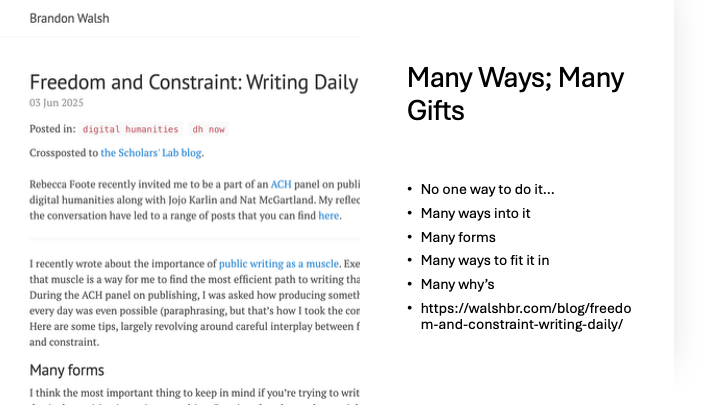
For one, we simply do not have the luxury of time. None of us do. But this is especially true for caregivers and those people and communities on whom this work disproportionately falls. When I sit down to write, I have to be able to write. I can’t wait for inspiration. So I’ve put together a range of strategies for getting thoughts out even when I feel like I have none to give. My colleague Amanda Wyatt Visconti and I have begun a series of multimedia experiments where we ask, “What would it look like to write a blog post by text? How about if we letter pressed a blog post? If you had to write just one sentence today what would it look like?” These playful constraints offer inspiration, motivation, and fun when writing might otherwise feel like a chore.
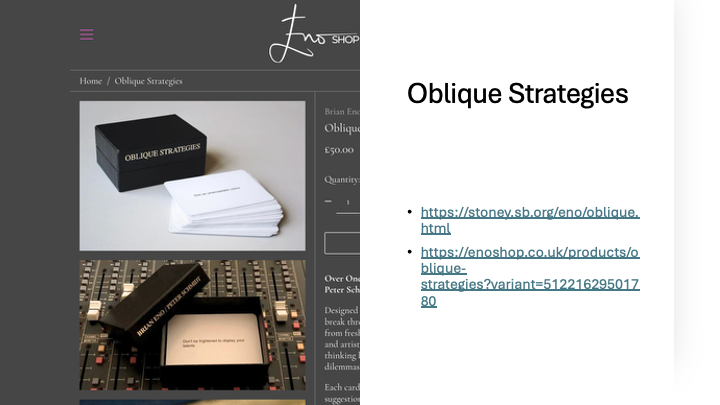
A tool I keep coming back to for this practice is the Oblique Strategies deck by Brian Eno and Peter Schmidt. You pull a card and get enigmatic phrases like “reverse it” or “turn it on its head” that can help you get around creative blocks. I’ve often used these cards to prompt me for blog posts. The deck is also available as a phone app. Central to this practice is the idea that the more you write the easier it gets. These throwaway prompts can create useful material I might use later, but, even if they don’t, I at least practice turning on the creative spigot such that I am ready to go when the time calls.
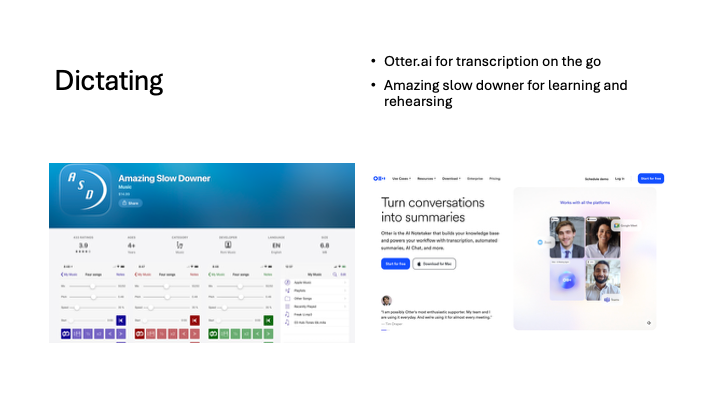
I have started being careful not to let any time slip through my grasp. This has meant dictating blog posts or material for a book project while driving to work using otter.ai. Does this material need a lot of editing? You bet. But it also means that I never feel as though I am faced with the tyranny of the blank page. I always have something to work on when I sit down at the keyboard. When prepping for talks, I use a companion tool from The Amazing Slow Downer that allows me to slow down, cut up, and loop my talks such that I can practice them on the go. The ASD is a tool I first used with music practice, but it’s proved to be very useful in my working life as well.
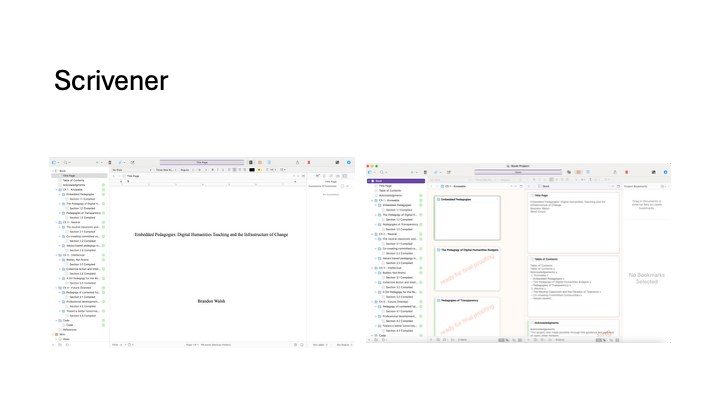
I have had less time for writing than ever before this year, but I have also produced far more than when I had vast oceans of time in the past. I think this is no happy accident. So much difference comes when you approach your work with intention and as a daily practice. I worked with Katina on a book proposal in the summer of 2024, and I tried hard to touch this project daily ever since. Some days this meant I dictated a paragraph in my car while driving. Most days, I was pressed to come up with at least one sentence. But I always tried to do so. These small pebbles add up to a great mound over time, those mounds into a mountain.
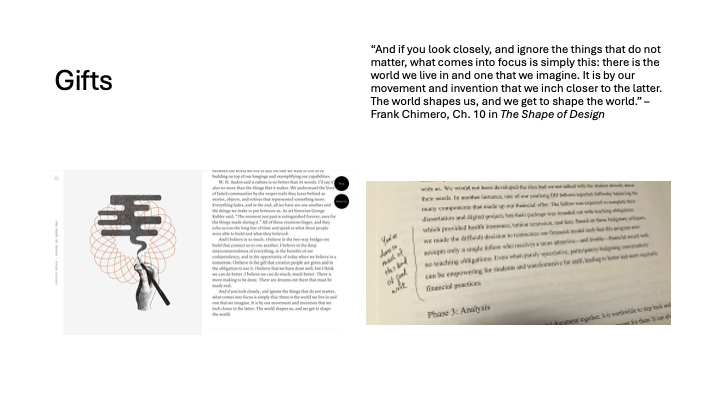
This year has reaffirmed for me the importance of writing as a daily intervention that means more than just the words you get to the page. Even as other, more important parts of my life have emerged, those margins in which I continue to try to make space continue to be powerful. I’m put in mind of Frank Chimero’s The Shape of Design, a text shared with me by my Scholars’ Lab colleague Jeremy Boggs. While the book describes design most directly, Chimero’s words are relevant to anyone who practices a creative craft:
“And if you look closely, and ignore the things that do not matter, what comes into focus is simply this: there is the world we live in and one that we imagine. It is by our movement and invention that we inch closer to the latter. The world shapes us, and we get to shape the world.”
This quote comes from Chimero’s chapter on gifts, which refers to his sense that creative work involves two distinct exchanges. The artist gifts their art, and this offering is then matched by the time and attention gifted back by the person who receives the artwork.
I’ve talked mostly about writing, but, in Chimero’s spirit, I want to close with a scene of reading. I started the year writing anxiously and against time pressures because of my own anxieties as a parent and person in the world. I hoped that the words might be useful for others, but to some degree I was writing for me, as a way to manage and process what is taking place in the world and workplace as I see it. At the end of this long year of writing, I placed the first print of my book manuscript in front of my supervisor and friend Amanda Wyatt Visconti. “Check this out,” I said, expecting a high five in response. Amanda took my manuscript and held it to their chest. (Sharing with permission here) Through tears, Amanda said, “Thank you—this is exactly what I needed today.” I had not intended to actually give that copy away. My text was far from ready for public consumption; it was incomplete and needed both developmental editing and proofing. But I certainly couldn’t take it back. I printed another and let Amanda have that copy.
As someone who has a lot of imposter syndrome about my work and my writing, I will be thinking about that moment for a long time. As I wrote on my blog, may we all be so lucky as to find readers as generous as Amanda, who see the power in our messy, imperfect work. We may not know what gifts we have. We may not even think of them as gifts until others receive them as such. We might write because we think we need to do so for us, but other, unknown readers might need it more.
And with that, I thank you for the gift of your attention.