Tables of Contents
29 Jan 2026 Posted in:digital humanities writing Tables of contents are spaces of imagination. Ideas to be shaped by the writer. Gifts to be received by the reader. Possibilities.
My graduate program required all PhD students to take a dissertation seminar. The usefulness of the course varied wildly from person to person, largely dependent on where you were in the process of developing your project. My wife recalls going through the motions during the meetings, for example, submitting assignments to check boxes but not in a position to benefit from them (her project took shape the year after she finished the seminar). I came to the course at just the right time, and the activities helped me narrow from a big baggy idea into an actionable proposal. The most powerful exercise given to us by our instructor asked us to develop a series of potential titles and speculative tables of contents. Something about the free-ranging possibilities clicked for me, and living among the imaginary chapter titles helped to solidify the shape of the thing to come. It’s an activity I often recommend to my students.
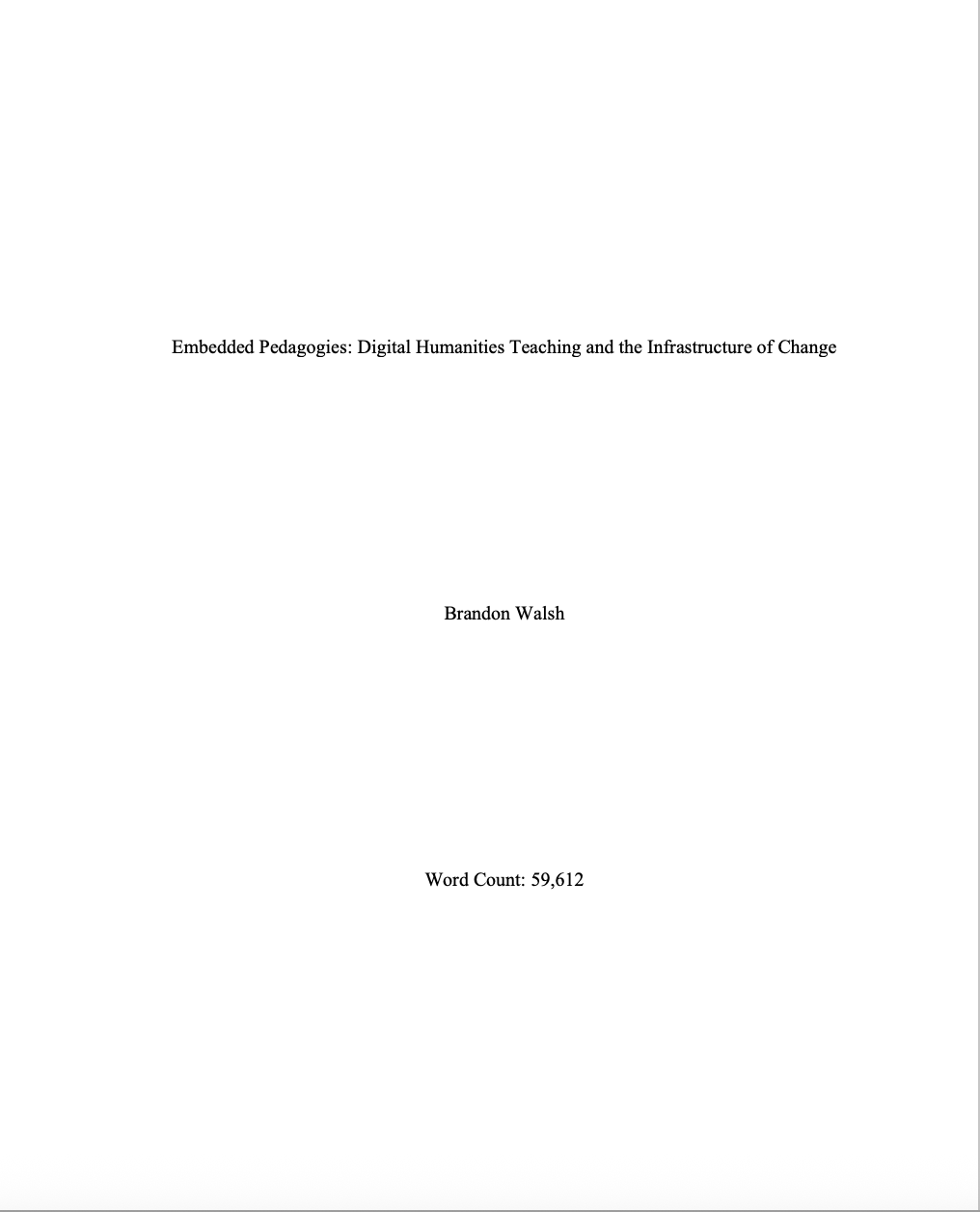
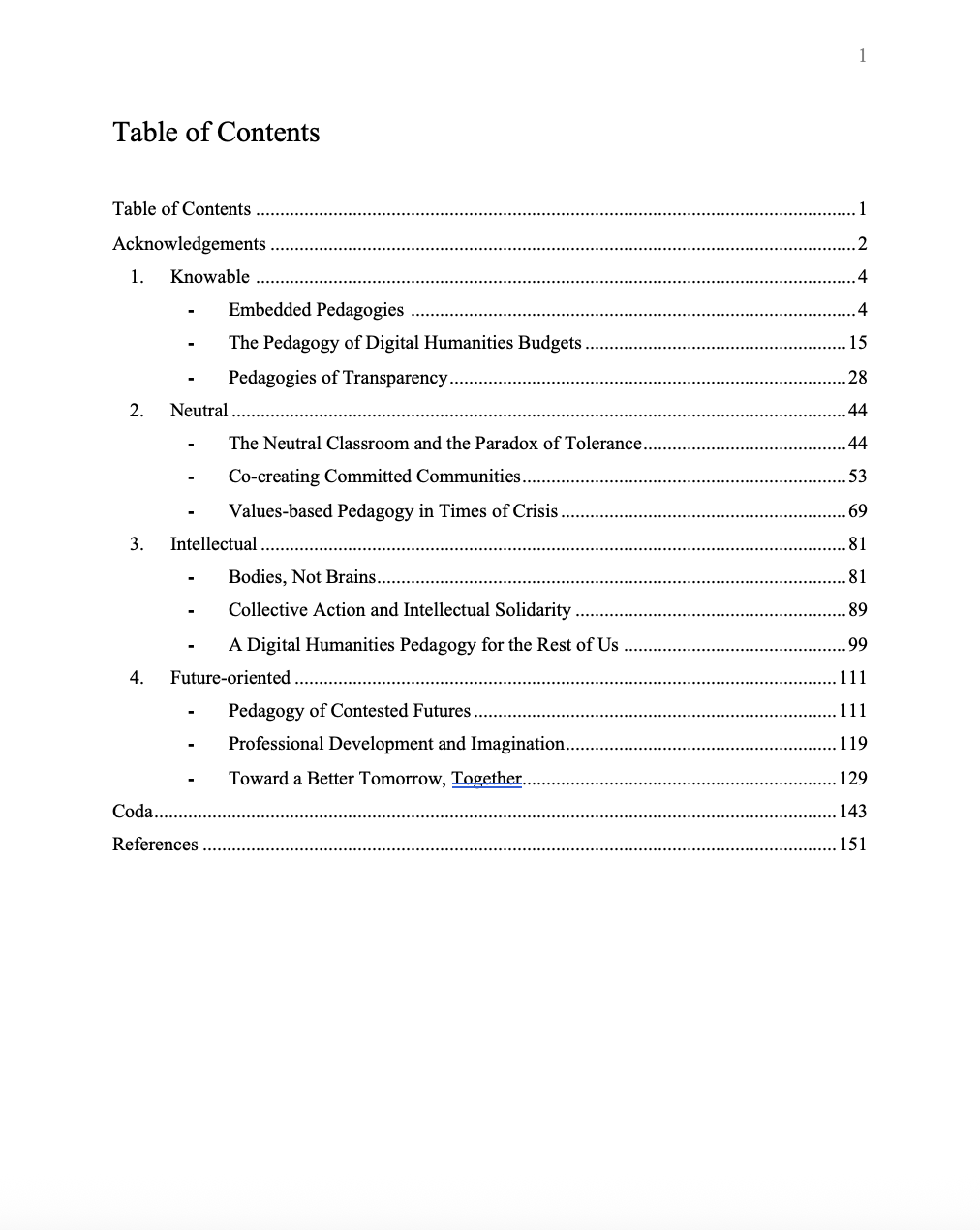
This past month I submitted the full manuscript of the book I’ve been working on to a publisher for consideration. The piece clocked in at 60,000 words, and I’ve blogged some of the material in this space. Things might change, but I wanted to mark the submission here by documenting my table of contents for Embedded Pedagogies such as it stands now. Screenshots follow from the manuscript, but I’ve also typed out the table of contents for ease of searching/screen reading.
Table of Contents
| Section | Page | |
|---|---|---|
| Table of Contents | 1 | |
| Acknowledgements | 2 | |
| 1. Knowable | 4 | |
| ⁃ Embedded Pedagogies | 4 | |
| ⁃ The Pedagogy of Digital Humanities Budgets | 15 | |
| ⁃ Pedagogies of Transparency | 28 | |
| 2. Neutral | 44 | |
| ⁃ The Neutral Classroom and the Paradox of Tolerance | 44 | |
| ⁃ Co-creating Committed Communities | 53 | |
| ⁃ Values-based Pedagogy in Times of Crisis | 69 | |
| 3. Intellectual | 81 | |
| ⁃ Bodies, Not Brains | 81 | |
| ⁃ Collective Action and Intellectual Solidarity | 89 | |
| ⁃ A Digital Humanities Pedagogy for the Rest of Us | 99 | |
| 4. Future-oriented | 111 | |
| ⁃ Pedagogy of Contested Futures | 111 | |
| ⁃ Professional Development and Imagination | 119 | |
| ⁃ Toward a Better Tomorrow, Together | 129 | |
| Coda | 143 | |
| References | 151 |